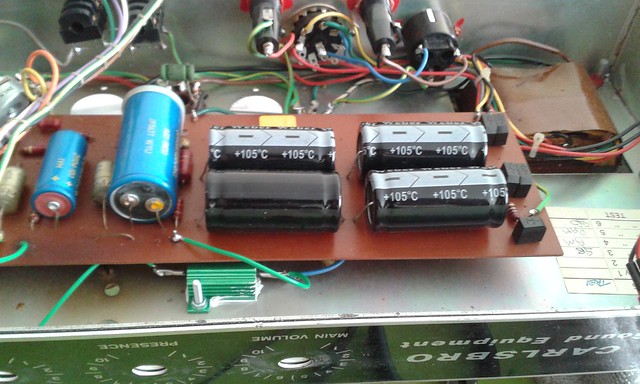
So, that Carlsbro PA 60 I took on from Mr. Foxen all that time ago is finally all fixed.
I got a big new resistor to replace the one that was smoking, wired everything up, put the valves in and tested it with the nearest convenient cab, which was a Peavey Deuce VT combo.
It crackled like Rice Krispies while Snap and Pop are on their hols. That was a shit metaphor but I'm keeping it, okay?
Anyway, fast forward past the eating lunch and doing the weekly shop and I lug the chassis upstairs to test it with my Orange OBC 115. And it appears that the thing actually works. Pots are a bit scratchy, but that's no biggie. It has a nice, warm clean sound and does not appear to drive the preamp by itself so that would need a booster. I ran my Retrovibe RVT-40 into it via my Nine of Swords Burial at Sea and it sounds pretty good running fuzz. I think with the right booster and right fuzz this amp could doom pretty hard.
Once it's been all cleaned up it will be put up for sale.
Showing posts with label projects. Show all posts
Saturday, 24 January 2015
Tuesday, 4 March 2014
Retrovibe RVT-40
Well, it works perfectly! The sound is so much clearer and definitely a bit more Rick-like when I have the settings right.
Can't wait to test it at band volume.
I may do a recording at some point.
Can't wait to test it at band volume.
I may do a recording at some point.
Saturday, 1 March 2014
Carlsbro PA60 Blues and Retrovibe RVT-40
The Carlsbro amp still isn't working. Having sorted the filter caps and the HT fuse (which it turns out needed to be slow-blow) the choke resistor (basically a great big resistor that sits between the power transformer and the rest of the circuit) is duff, smoking when the power's on and reading about twice as much as it is supposed to. Sigh.
I've also rewired my Retrovibe RV-4 to roughly approximate the wiring of a Peavey T-40 bass. Thus, Retrovibe RVT-40. I got all excited when I finished it and forgot to get a picture of the wiring, but here's the outside of the bass with classy-looking new knobs and a wee switch that does phasey stuff to the bridge pickup (in theory) and the T-40 wiring diagram.
I can't test that it works until tomorrow, on accout of it being quarter to eleven at night... but once it is tested I'll report back either in celebration or lamentation.
I've also rewired my Retrovibe RV-4 to roughly approximate the wiring of a Peavey T-40 bass. Thus, Retrovibe RVT-40. I got all excited when I finished it and forgot to get a picture of the wiring, but here's the outside of the bass with classy-looking new knobs and a wee switch that does phasey stuff to the bridge pickup (in theory) and the T-40 wiring diagram.
I can't test that it works until tomorrow, on accout of it being quarter to eleven at night... but once it is tested I'll report back either in celebration or lamentation.
Sunday, 26 January 2014
Things are afoot...
So, it appears to be all go here at Atomic Tangerine.
Not only am I soon to take on my second non-personal guitar upgrade, but I've taken on a project from Mr. Foxen.
The guitar upgrade is a simple electronics and pickups replacement for a dude who wants a bit more punch and versatility from his Epiphone SG. Pickups will come from IronGear.
The project from Mr. Foxen is a Carlsbro PA 60. Basically a 60 watt all valve amp head originally intended for PA use. Pretty much a win-win situation as I get to do more learning and Foxen gets more of his to-do pile finished.
Not only am I soon to take on my second non-personal guitar upgrade, but I've taken on a project from Mr. Foxen.
The guitar upgrade is a simple electronics and pickups replacement for a dude who wants a bit more punch and versatility from his Epiphone SG. Pickups will come from IronGear.
The project from Mr. Foxen is a Carlsbro PA 60. Basically a 60 watt all valve amp head originally intended for PA use. Pretty much a win-win situation as I get to do more learning and Foxen gets more of his to-do pile finished.
Labels:
amps,
Carlsbro PA 60,
Epiphone SG,
guitar,
learning,
projects,
valve amps,
work
Sunday, 24 March 2013
Bass Build - Part Zero
Well... it's been a while.
Scored a cheapish bass neck on eBay and luckily was able to offset the cost against selling something else so do not have to actually spent any money on it. Going to make a start on my bass build.
Only thing I'm not sure about is that the body will be made from multiple bits of plywood, but it is Grade A stock so hopefully should be okay. As it's a first build it's more about the learning process anyway. Second build (if this one doesn't put me off forever) will be made from proper wood.
Scored a cheapish bass neck on eBay and luckily was able to offset the cost against selling something else so do not have to actually spent any money on it. Going to make a start on my bass build.
Only thing I'm not sure about is that the body will be made from multiple bits of plywood, but it is Grade A stock so hopefully should be okay. As it's a first build it's more about the learning process anyway. Second build (if this one doesn't put me off forever) will be made from proper wood.
Sunday, 5 August 2012
Flying V Bass Body
Further to previous posting I have now received the Flying V bass body. It's in pretty good nick overall, and seems to be made from a decent, solid hardwood (Not sure what type. Looks mahoganyish).
The previous owner has already had a go at removing the existing finish, which will make it a bit easier for me to strip the remainder and get some decent laquer on.
This project is likely to cost a bit, as cheap aftermarket bass soapbar pickups and non-Fender-style necks don't really exist so it's most likely that I'll be going with Seymour Duncan or maybe Kent Armstrong for the pickups and unless a better alternative presents itself Warmoth for the neck. Seeing as how everything else is going to have to be a more expensive option I might as well get a Hipshot bridge as well. And then this'll become my main bass so I can damn well get my money's worth from it!
The previous owner has already had a go at removing the existing finish, which will make it a bit easier for me to strip the remainder and get some decent laquer on.
This project is likely to cost a bit, as cheap aftermarket bass soapbar pickups and non-Fender-style necks don't really exist so it's most likely that I'll be going with Seymour Duncan or maybe Kent Armstrong for the pickups and unless a better alternative presents itself Warmoth for the neck. Seeing as how everything else is going to have to be a more expensive option I might as well get a Hipshot bridge as well. And then this'll become my main bass so I can damn well get my money's worth from it!
Sunday, 29 July 2012
Recent Purchases
It's all go here chez Dreadful... at least planning-wise it is...
Recently got a Crafter Junior guitar neck off eBay to go with the Squier Strat body I got off Mr. Foxen. The neck pocket will need to be made a little bigger but that's not a huge issue. Also going to get some Nitromors or somesuch soon to remove the 'burst finish and once that's done FiL will help me out filling the trem cavity and sorting out the channel someone thought it'd be awesome to chisel between the control and jack cavities. Electronics and hardware plans have already been covered here if you're interested.
And I'll soon be getting another bit of wood from eBay, this time a Flying V-style bass body (which may or may not include bridge and tuners). £21 including postage seems a pretty damn good deal to me. That's going to either get soapbar pickups or I'll fill in the pickup cavities so I can put P-bass style split coils in.
So now I'd best start budgeting for all the other parts I need.
Recently got a Crafter Junior guitar neck off eBay to go with the Squier Strat body I got off Mr. Foxen. The neck pocket will need to be made a little bigger but that's not a huge issue. Also going to get some Nitromors or somesuch soon to remove the 'burst finish and once that's done FiL will help me out filling the trem cavity and sorting out the channel someone thought it'd be awesome to chisel between the control and jack cavities. Electronics and hardware plans have already been covered here if you're interested.
And I'll soon be getting another bit of wood from eBay, this time a Flying V-style bass body (which may or may not include bridge and tuners). £21 including postage seems a pretty damn good deal to me. That's going to either get soapbar pickups or I'll fill in the pickup cavities so I can put P-bass style split coils in.
So now I'd best start budgeting for all the other parts I need.
Monday, 30 April 2012
Squier Strat Body
And here's the Strat body I got off Oli.

Tentative plan is strip, fill in the various holes including the channel that has been cut between the jack socket cavity and the control cavity*, refinish, and then load up an HH scratchplate from Axes 'R' Us with some GFS Mean 90s and wire it up using master volume, master tone and a 4-way blade switch (allowing series/parallel switching). Thinking I may go with black hardware.
*The 'plate has been taken off at least once before (badly, judging by the state of the screw heads) so I'm assuming whoever did it decided they'd rather hack up the body of their guitar than desolder or just plain cut the wires going to the socket.
Tentative plan is strip, fill in the various holes including the channel that has been cut between the jack socket cavity and the control cavity*, refinish, and then load up an HH scratchplate from Axes 'R' Us with some GFS Mean 90s and wire it up using master volume, master tone and a 4-way blade switch (allowing series/parallel switching). Thinking I may go with black hardware.
*The 'plate has been taken off at least once before (badly, judging by the state of the screw heads) so I'm assuming whoever did it decided they'd rather hack up the body of their guitar than desolder or just plain cut the wires going to the socket.
Sunday, 22 April 2012
First Job - Rockwood by Hohner LX90L
And so here it is, the first project I'm doing for somebody else!

Popped round to my friend Joe's earlier for a cuppa and noticed he had a Strat copy sat in the corner, which I promptly offered to fix up for him. The guitar is a Rockwood by Hohner LX90L, which as Strat copies go is, admittedly, pretty low end.

Yes, the body really is made from fibreboard.
From what I can tell it has a reasonable sound (it only had three very old strings on it and it's very noisy) and doesn't play too badly either. As is to be expected on a cheaper guitar those electronics have to go, so I might as well go the whole hog and get CTS pots and a Sprague 'Orange Drop' cap, and once that's done I'll re-assess the pickups. Further reports when there's something to report!
Popped round to my friend Joe's earlier for a cuppa and noticed he had a Strat copy sat in the corner, which I promptly offered to fix up for him. The guitar is a Rockwood by Hohner LX90L, which as Strat copies go is, admittedly, pretty low end.
Yes, the body really is made from fibreboard.
From what I can tell it has a reasonable sound (it only had three very old strings on it and it's very noisy) and doesn't play too badly either. As is to be expected on a cheaper guitar those electronics have to go, so I might as well go the whole hog and get CTS pots and a Sprague 'Orange Drop' cap, and once that's done I'll re-assess the pickups. Further reports when there's something to report!
Saturday, 31 March 2012
Lestelepaulcaster Design
Well, I'm still no closer to actually being able to build the guitar, but thanks to this software and some subsequent fiddling in MS Paint I have at least come up with a picture of what I intend the guitar to look like.
Friday, 16 March 2012
Boss PH-2 Super Phaser - Gain Mod
Just did a simpified version of the gain mod from this site. The plan there is to remove the 27k resistor at R79 the PH-2 comes with and then do a switching thing between that and a 15k resistor (basically, lower resistance value means more volume), but really I cannot think of a reason why I'd need to switch between usable volume and really noticable drop in volume, so I went for the 'usable volume' option only, by doing a straight swap of the two resistors.
The picture isn't great as I still cannot find my camera, and my smartphone doesn't have a macro function that I can find, but helpfully the new resistor is bright blue and about twice the size of all the existing ones so it does stick out a bit.

Just did a quick test and it works a treat, now there is no volume drop at all when the phaser is switched on. I'd call that a win really.
The picture isn't great as I still cannot find my camera, and my smartphone doesn't have a macro function that I can find, but helpfully the new resistor is bright blue and about twice the size of all the existing ones so it does stick out a bit.
Just did a quick test and it works a treat, now there is no volume drop at all when the phaser is switched on. I'd call that a win really.
Wednesday, 14 March 2012
Fender Jag-Stang & Boss PH-2 Super Phaser
Righto, I have a Fender Jag-Stang in bits that I want to really do something special with.
It's gonna be a quite a big project, as it'll have a complete refin on the body (including addition of tummy and forearm contours whilst it's naked), new scratchplate, new electronics (including different controls), new pickups and I'll be immobilising the bridge.
One thing that strikes me is that I rather like the look of matching headstocks on Fender-style instruments, so I'm considering it with this project. But I'm also wary of obliterating the 'Fender Jag-Stang' decal because even with keeping the serial number it may adversely affect the value should I decide to sell it on... I mean, yes by that point very little of what's on the guitar will be original anyway but people do get quite worked up over having the 'right' name.
Something to think on, and any comments on the matter are gratefully recieved.
In other news I'll be replacing the gain resistor in my Boss PH-2 Super Phaser at some point during the next couple of days as it needs a bit more oomph when I'm actually using it; when you;re into playing loud psychedelic doom stuff a pedal that actually drops the volume when switched on isn't that useful.
It's gonna be a quite a big project, as it'll have a complete refin on the body (including addition of tummy and forearm contours whilst it's naked), new scratchplate, new electronics (including different controls), new pickups and I'll be immobilising the bridge.
One thing that strikes me is that I rather like the look of matching headstocks on Fender-style instruments, so I'm considering it with this project. But I'm also wary of obliterating the 'Fender Jag-Stang' decal because even with keeping the serial number it may adversely affect the value should I decide to sell it on... I mean, yes by that point very little of what's on the guitar will be original anyway but people do get quite worked up over having the 'right' name.
Something to think on, and any comments on the matter are gratefully recieved.
In other news I'll be replacing the gain resistor in my Boss PH-2 Super Phaser at some point during the next couple of days as it needs a bit more oomph when I'm actually using it; when you;re into playing loud psychedelic doom stuff a pedal that actually drops the volume when switched on isn't that useful.
Wednesday, 8 February 2012
Retrovibe RV4 Coil Split
At some point I'm planning to do a coil split on my Retrovibe RV4 so I can get ALL THE TONES from it.
The question is which method to use for achieving this?
The most obvious is to buy a couple of push/pull pots and use those (plus another one for series/parallel switching). The problem with that is that it costs money and I'm currently an unemployed bum.
The next two options are probably better as I can do them with stuff I have about the house.
First is to utilise one or both tone controls to this end, providing me with a variable coil split on one or both pickups (and either one master tone control, or no tone control) which is better as I can then minutely adjust the perfect sound, instead of the simple one-or-both that straight forward switching offers.
Second (and probably vastly more unusual) is to have, basically, four volume controls; one for each coil. I know this is possible as there are diagrams for using such a set up with single pickup passive MM-style basses. I have no idea whatsoever whether this would be at all worth it, but it'd be an interesting experiment nonetheless.
The question is which method to use for achieving this?
The most obvious is to buy a couple of push/pull pots and use those (plus another one for series/parallel switching). The problem with that is that it costs money and I'm currently an unemployed bum.
The next two options are probably better as I can do them with stuff I have about the house.
First is to utilise one or both tone controls to this end, providing me with a variable coil split on one or both pickups (and either one master tone control, or no tone control) which is better as I can then minutely adjust the perfect sound, instead of the simple one-or-both that straight forward switching offers.
Second (and probably vastly more unusual) is to have, basically, four volume controls; one for each coil. I know this is possible as there are diagrams for using such a set up with single pickup passive MM-style basses. I have no idea whatsoever whether this would be at all worth it, but it'd be an interesting experiment nonetheless.
Sunday, 6 November 2011
Lestelepaulcaster
Having thought about the design of the guitar me and FiL are going to build I'm leaning heavily in the direction of a Les Paul/Telecaster hybrid... something similar to the Fano Alt de Facto SP6.
I've been mulling the idea around in my brain for a little while and after going to look for it online to see if anyone else had done something similar it not only turned out that they had, but that it actually works.
The major difference between the Fano and my idea is that I'm intending to have a 25.5" scale and a Tele-style headstock (mostly because I get on better with 6-in-a-line tuners). Materials are still a bit of an unknown, apart from knowing that FiL can source maple for the neck. Not sure exactly how I plan on doing the controls yet, but I suspect I'll go down the route of each pickup having its own volume and tone pots for maximum versatility.
I'm feeling rather excited by this.
I've been mulling the idea around in my brain for a little while and after going to look for it online to see if anyone else had done something similar it not only turned out that they had, but that it actually works.
The major difference between the Fano and my idea is that I'm intending to have a 25.5" scale and a Tele-style headstock (mostly because I get on better with 6-in-a-line tuners). Materials are still a bit of an unknown, apart from knowing that FiL can source maple for the neck. Not sure exactly how I plan on doing the controls yet, but I suspect I'll go down the route of each pickup having its own volume and tone pots for maximum versatility.
I'm feeling rather excited by this.
Saturday, 5 November 2011
Let the planning commence...
Spoke to my father-in-law this morning... not only is he happy to help me out with building a guitar, but he reckons he can source the wood for it as well.
WIN.
Sunday, 30 October 2011
Harley Benton GA5 head - It's alive! IT'S ALI- oh..
Time for the chassis out, valves uncovered test.
All plugged in, volume all the way down, power on... valves warm up and are glowing nicely so I slowly roll up the volume. And I get a sound! Strum a bit, and I get some decent clean sound, roll up the tone and the sound gets a little bassier... so far so good. Strum a few more times... and with a sound I can best describe as a 'squeak' the amp stops working again.
Hmmm...
Next step is giving all the components a quick once over, visually and with multimeter, just to make sure everything's okay.
After that, it's time to get reading because if there's not anything that's obviously blown up/melted/phased out of reality I really have no idea what's happened.
All plugged in, volume all the way down, power on... valves warm up and are glowing nicely so I slowly roll up the volume. And I get a sound! Strum a bit, and I get some decent clean sound, roll up the tone and the sound gets a little bassier... so far so good. Strum a few more times... and with a sound I can best describe as a 'squeak' the amp stops working again.
Hmmm...
Next step is giving all the components a quick once over, visually and with multimeter, just to make sure everything's okay.
After that, it's time to get reading because if there's not anything that's obviously blown up/melted/phased out of reality I really have no idea what's happened.
Harley Benton GA5 head - Power up and begin troubleshooting
So, with the chassis back in the box (probably unneccessary, but I did it anyway) I took the amp upstairs, plugged it into my 4x12, switched it on and... nothing. Not a jot. Not even a hiss or hum.
I know it's not a problem with the speaker cable or cab, as I tested them using my Peavey Road Master head just now and they work fine. So what other possible issues could there be?
I don't think it's the EL84 (power amp valve) as that was glowing quite happily when I looked in the back of the head. No idea if the 12AX7 was glowing as it's in a metal tube thing so obviously I can't see it. Next power-on test will be chassis out, valves uncovered so I can see them both. In the mean time I'm going to have a closer look at all the connections within the amp and double double check that nothing's loose or broken. Also going to bodge some means of keeping that in-line fuse thingy closed in case that's a problem.
I know it's not a problem with the speaker cable or cab, as I tested them using my Peavey Road Master head just now and they work fine. So what other possible issues could there be?
I don't think it's the EL84 (power amp valve) as that was glowing quite happily when I looked in the back of the head. No idea if the 12AX7 was glowing as it's in a metal tube thing so obviously I can't see it. Next power-on test will be chassis out, valves uncovered so I can see them both. In the mean time I'm going to have a closer look at all the connections within the amp and double double check that nothing's loose or broken. Also going to bodge some means of keeping that in-line fuse thingy closed in case that's a problem.
Saturday, 29 October 2011
Harley Benton GA5 head
Wow... turns out it's been nearly a month since I last updated this blog. That's mostly due to the fact I haven't really done any project stuff in that time. Which is lame as I still have that Swift LP copy to finish off.
Anyway, today I went to Bristol and picked up a non-working Harley Benton GA5 head for £10. The GA5 is basically an Epiphone Valve Junior with a tone control added and with the "Valve Junior" scraped off the PCB. I've had a look inside and can see no obvious problems (exploded components, loose wires, etc.) so tomorrow will power it up and see if it makes a noise. When I originally took the back off I noticed some kind of broken plastic thingy containing a fuse coming out of one of the transformers and thought that might be the problem but looking inside the wire doesn't connect to anything so I assme it's a bit of generic construction and whether it gets connected to anything depends on other factors (I suspect it'll be something to do with the country it's going to be used in).
Anyway, here are some pictures. It's not a bad looking little amp really. I've called it Bert.


Quite pleased with this really... needs a whole bunch of work doing; even if it did work some of the components probably aren't as good as they could be and I'm not sure I'm keen on all those floating resistors.
Anyway, today I went to Bristol and picked up a non-working Harley Benton GA5 head for £10. The GA5 is basically an Epiphone Valve Junior with a tone control added and with the "Valve Junior" scraped off the PCB. I've had a look inside and can see no obvious problems (exploded components, loose wires, etc.) so tomorrow will power it up and see if it makes a noise. When I originally took the back off I noticed some kind of broken plastic thingy containing a fuse coming out of one of the transformers and thought that might be the problem but looking inside the wire doesn't connect to anything so I assme it's a bit of generic construction and whether it gets connected to anything depends on other factors (I suspect it'll be something to do with the country it's going to be used in).
Anyway, here are some pictures. It's not a bad looking little amp really. I've called it Bert.
Quite pleased with this really... needs a whole bunch of work doing; even if it did work some of the components probably aren't as good as they could be and I'm not sure I'm keen on all those floating resistors.
Saturday, 1 October 2011
Project Weekend! - Swift Les Paul copy
I've almost completed rebuilding the Les Paul copy. The new electronics have been installed (after some chiseling and a lot of filing as the CTS pots are larger than the ones that came in the guitar). I've chosen to wire it in the 1950s Gibson style, mostly becaue I could, really.
The only problem is the I'm missing one of the bridge posts and the nut, so I've had to order new ones as I am seriously stumped as to where the originals have ended up.
Photos of my embarrassing soldering will be posted tomorrow.
The only problem is the I'm missing one of the bridge posts and the nut, so I've had to order new ones as I am seriously stumped as to where the originals have ended up.
Photos of my embarrassing soldering will be posted tomorrow.
Tuesday, 27 September 2011
Swift Les Paul Copy - Bits n' Pieces
The new electronics for the Swift LP copy arrived this morning. I probably won't be able to actually install them until next week, but I'll list them here anyway.
I have bought, from Axes R Us, the following:
Basically the aim here is to replicate the actually not-too-bad sound of the original setup using better quality parts. I've also taken the decision to use a lower value cap for the neck tone control just to reduce the amount of mud a bit.
ETA: I've just taken measurement of the DC resistance of the stock pickups... the neck came in at 9.9Kohm and the bridge at 10.1Kohm. Not as much of a difference as expectations nor conventional wisdom demanded, but no biggie... I mean, twin P90s are often the same value the difference being made in how close they are to the strings.
I have bought, from Axes R Us, the following:
- 2x CTS 250K linear pots (tone)
- 2x CTS 250K logarithmic pots (volume)
- 1 .47uf Sprague "Orange Drop" capacitor for the bridge tone control
- 1 .33uf Sprague "Orange Drop" capacitor for the neck tone control
- 1 three-way toggle switch
- 1 mono jack socket
- Various bits of wire
Basically the aim here is to replicate the actually not-too-bad sound of the original setup using better quality parts. I've also taken the decision to use a lower value cap for the neck tone control just to reduce the amount of mud a bit.
ETA: I've just taken measurement of the DC resistance of the stock pickups... the neck came in at 9.9Kohm and the bridge at 10.1Kohm. Not as much of a difference as expectations nor conventional wisdom demanded, but no biggie... I mean, twin P90s are often the same value the difference being made in how close they are to the strings.
Subscribe to:
Posts (Atom)
